
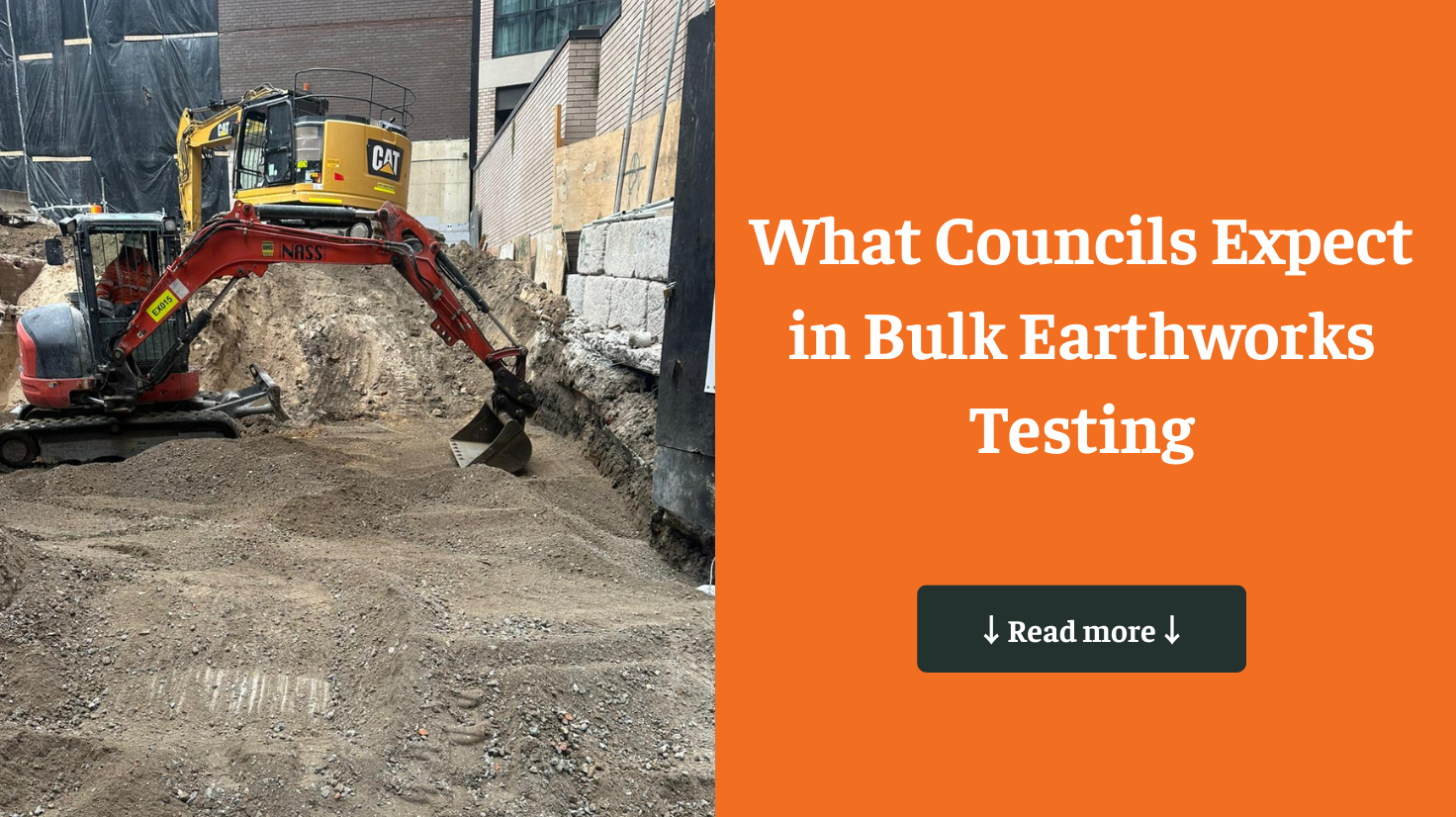
Meeting council requirements is one of the most important compliance steps in any civil or subdivision project in NSW. Bulk earthworks testing must be conducted correctly — and documented properly — for councils to approve construction works, issue compliance certificates, or sign off subdivision stages.
For a breakdown of a full bulk earthworks testing process, you can also refer to our NSW guide here:
👉 https://idealgeotech.com.au/bulk-earthworks-testing-nsw/
This article explains the rules, the required documentation, and what contractors must prepare to ensure compliance with council earthworks requirements in NSW.
1. Council Rules for Bulk Earthworks in NSW
Although each local council has its own development guidelines, most follow the same core expectations based on national and state-wide standards. Two important references are:
-
Wollongong City Council — its “Earthworks / Land Reshaping Works” policy outlines how fill must be controlled, tested, and documented when performing earthworks. City of Wollongong
-
NSW Environment Protection Authority (EPA) regulations on clean fill and recycled soil — under the Resource Recovery Exemptions, only suitable soil (clean, uncontaminated, tested) may be reused as fill. EPA NSW+2EPA NSW+2
Key Council/Regulatory Requirements
-
Follow recognised earthworks standards — councils expect earthworks to comply with accepted practices regarding fill quality, compaction, and fill testing.
-
Use controlled, certified fill — uncontrolled fill with unknown composition, contamination, or organic content is typically not accepted. Using fill must comply with EPA clean-fill guidelines or equivalent.
-
Provide documentation for fill and earthworks — including test reports, material certifications, and compliance statements.
-
Test and supervise compaction and placement — many councils require documented compaction testing and supervision to ensure fill and subgrade stability.
-
Ensure environmental and contamination compliance — particularly when importing, supplying or reusing fill material, to comply with waste and environmental laws.
Because of these regulations, contractors must treat bulk earthworks as a compliance — not only construction — task.
2. Documentation Councils Require for Earthworks Compliance
Even if earthworks are performed correctly, missing or incomplete paperwork can delay approvals or cause refusals. Councils expect a comprehensive and traceable documentation package.
2.1 Fill Material Certification & Clean-Fill / Waste Classification
When fill is imported, reused or recycled, contractors must provide certification that material meets EPA or council standards for “clean fill” or “approved engineering fill.” The EPA’s guidance on Resource Recovery Exemptions outlines the criteria for legally reusing soil or excavated natural material. EPA NSW+2EPA NSW+2
2.2 Compaction & Field Testing Reports
Each lift or layer of fill/subgrade must usually be tested for density, moisture content, and compaction compliance. Reports must contain clear documentation of test locations, dates, results, and conformity with specifications.
2.3 Laboratory Test Results (If Fill is Imported or Variable)
For fill sourced off-site, councils often require lab testing such as particle size distribution (PSD), plasticity/Atterberg limits, and contaminant screening, to confirm material suitability.
2.4 Earthworks Conformance Report & Supervision Certificate
A “conformance report” summarises the earthworks scope, material status, testing programme, compliance with standards, and sign-off by qualified geotechnical practitioners. Many councils rely on these reports (rather than just builder declarations).
2.5 Site Plans & Test Location Maps
Submitted documentation should include marked site plans showing where tests were taken and how fill was placed, cut/fill boundaries, contours, levels, and compliance with approved drawings — especially important for subdivisions or large developments.
3. Why Compliance Matters
Non-compliance can lead to severe consequences:
-
Delay or refusal of approval / subdivision certificates
-
Expensive rework or re-compaction
-
Structural risks — settlement, instability, non-conforming fill
-
Environmental and legal liability if contaminated or unapproved fill is used
-
Damage to reputation for contractors / developers
Because bulk earthworks are an early stage in any project, compliance failures at this point often create downstream delays and increased costs.
4. CTA — Need Earthworks Testing That Meets Council Requirements in NSW?
If you want full compliance with council earthworks requirements in NSW — from material certification, fill verification, compaction testing, laboratory analysis, site supervision to final reports — we provide comprehensive, professional earthworks testing services tailored to NSW councils and regulations.
Request Earthworks Compliance Testing
Fast, accurate, NSW-wide service.
Your customer-focused soil tester for bulk earthworks.