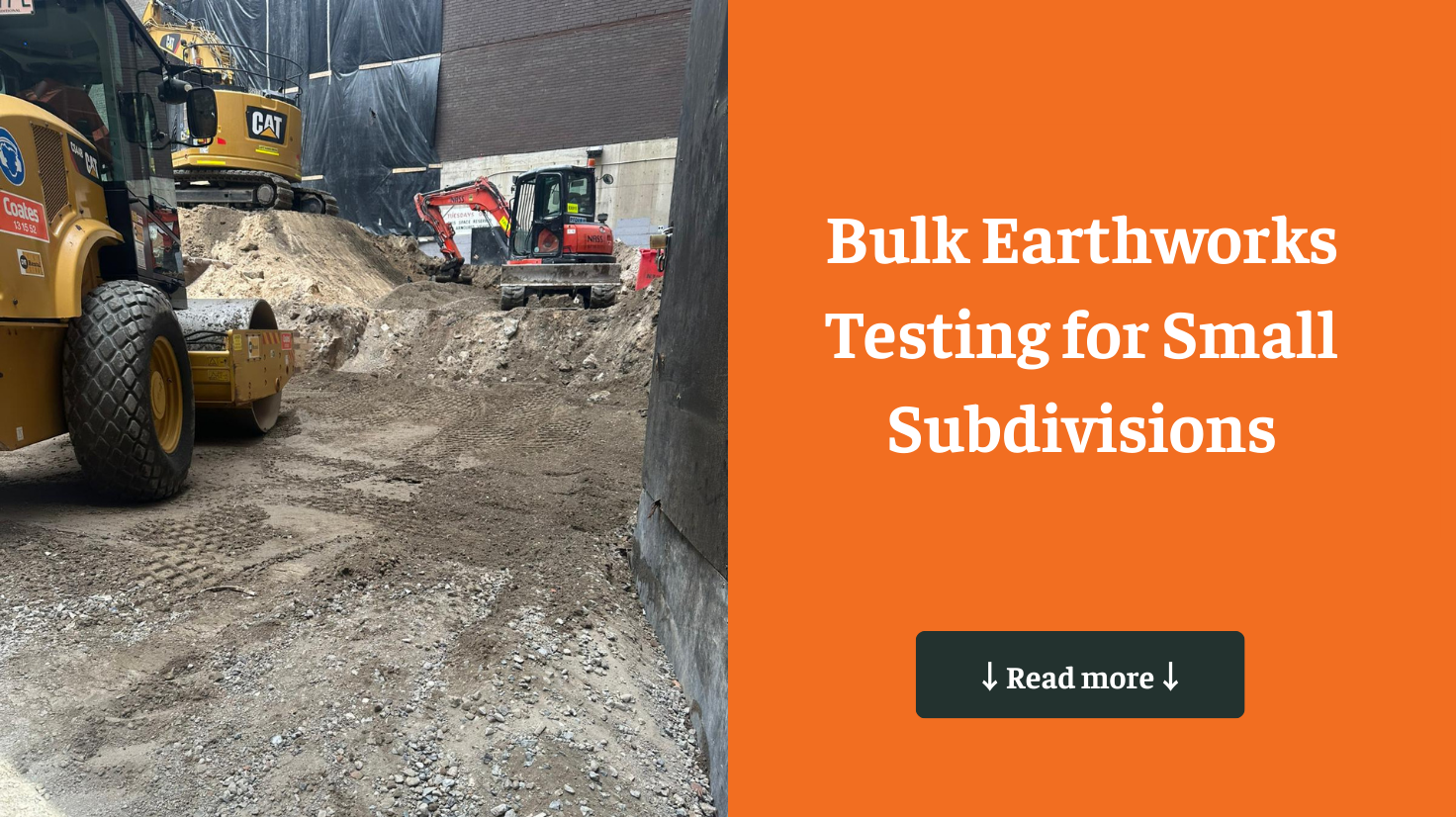
Small subdivisions still carry big compliance requirements — especially when it comes to bulk earthworks. Whether you’re creating two lots or twenty, councils across NSW require proper testing, documentation, and certification before construction can move to the next stage.
Skipping or rushing this step can lead to inspection failures, rework costs, legal issues, and delays in obtaining subdivision certificates.
For a full overview of the bulk earthworks process, you can also refer to our NSW testing guide here:
👉 https://idealgeotech.com.au/bulk-earthworks-testing-nsw/
This article explains the common issues small subdivision developers face, the testing required, and how professional verification streamlines council approval.
1. Common Issues in Earthworks for Small Subdivisions
Even minor developments can run into major earthworks problems if testing is not done correctly or early enough. Here are the most frequent issues affecting subdivisions across NSW.
1.1 Inconsistent Fill Quality
Subdivision earthworks often involve importing fill to build platforms, reshape lots, or create access roads. Poor-quality or uncontrolled fill can lead to:
-
settlement and subsidence
-
soft spots beneath driveways or slabs
-
density test failures
-
refusal of Level 1 certificates
Because small subdivisions have tight space, unsuitable fill quickly becomes a costly challenge.
1.2 Poor Compaction or Incorrect Layering
If fill is placed in layers that are too thick, too wet, or not compacted properly, councils will not accept the completed earthworks.
Common signs include:
-
rutting
-
pumping material
-
uneven platforms
-
cracking after rain
This results in additional compaction or excavation, increasing project costs.
1.3 Lack of Documentation for Council Approval
Most councils require:
-
compaction test reports
-
Level 1 supervision documentation (if applicable)
-
test location plans
-
material certifications
Many small developers fail inspections simply because documentation is incomplete or late — even if the work itself is compliant.
1.4 Drainage & Moisture Issues
Small subdivisions often involve reshaping ground near boundaries or existing structures. Poor drainage can cause:
-
water pooling
-
unstable subgrade
-
erosion
-
compaction failures
This is a common reason councils request additional testing or refuse sign-off.
1.5 Disturbance of Reactive or Variable Soils
Much of NSW includes reactive clay or mixed soil profiles. Small subdivisions built on variable ground need thorough testing to prevent:
-
slab movement
-
footing failures
-
long-term structural issues
Early geotechnical input reduces these risks dramatically.
2. Essential Earthworks Testing for Subdivision Compliance
To meet earthworks testing subdivision requirements in NSW, contractors must provide verifiable results from both field and laboratory tests. These confirm that fill is suitable, correctly compacted, and compliant with council expectations.
2.1 Field Density Testing
Used to verify each layer meets compaction requirements.
Includes:
-
dry density
-
moisture content
-
maximum dry density (MDD) comparisons
If any layer fails, remediation may be required before moving forward.
2.2 Level 1 Supervision (AS 3798)
Many councils require Level 1 supervision for subdivisions, meaning a qualified geotechnical engineer or technician observes placement and compaction full-time.
This produces:
-
daily inspection records
-
test results
-
conformance summaries
-
formal Level 1 certificate
This is one of the most important documents for subdivision approval.
2.3 Laboratory Testing of Imported Fill
Where fill is brought onsite, the following tests may be required:
-
PSD (Particle Size Distribution)
-
Atterberg Limits
-
Moisture content
-
CBR testing (for driveways, pavements, and roads)
These confirm the material behaves as engineered fill.
2.4 Subgrade Assessment for Roads and Driveways
Small subdivisions often require new pavement areas, where councils expect:
-
subgrade strength testing
-
CBR verification
-
proof of compaction
Skipping this stage may lead to pavement failure or drainage issues later.
2.5 Test Location Mapping
Councils frequently request test points marked on:
-
subdivision plans
-
cut/fill diagrams
-
compaction zones
Clear mapping speeds up approval and reduces back-and-forth communication.
3. Need Earthworks Testing for a Small Subdivision?
If you want fast, compliant and reliable earthworks testing for subdivisions, we provide:
-
Level 1 supervision (AS 3798)
-
subdivision earthworks certification
-
compaction testing
-
imported fill verification
-
CBR and subgrade assessment
-
earthworks conformance reporting
Request Subdivision Earthworks Testing
Fast turnaround. Clear reporting. Council-ready documentation.
Your customer-focused soil tester for bulk earthworks.
Thinking about a geotechnical report for your project?
Get a fast, accurate, fixed-price report designed for your site conditions.
Request a Quote